
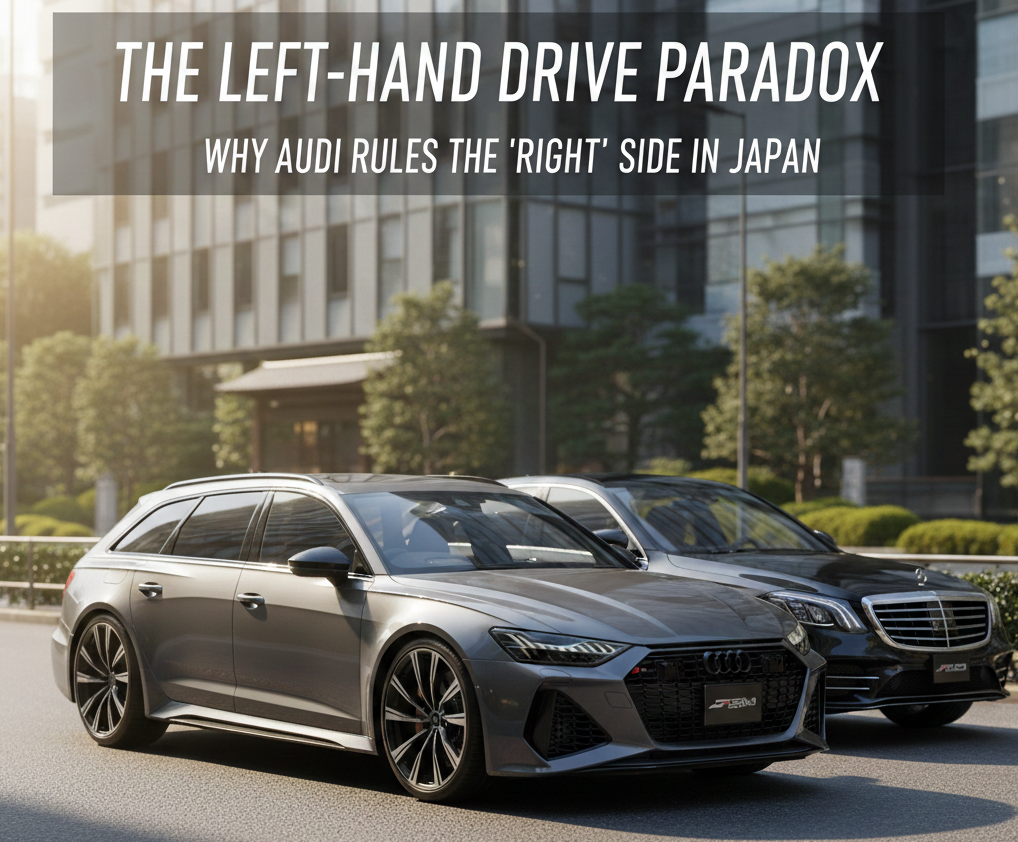
If you’ve ever scrolled through Japanese car auctions, you’ll notice a strange pattern. You’ll see rows of Porsche 911s and Mercedes-Benz S-Classes with the steering wheel on the left (LHD), but almost every Audi—from the A3 to the mighty RS6—has the wheel on the right (RHD).
In a country that drives on the left, why is the “wrong side” so popular for some, yet avoided by Audi?
Status vs. Sophistication
For decades, owning a “Hidari-handle” (left-handle) car in Tokyo was the ultimate status symbol. It shouted, “This isn’t a local car; this is a European masterpiece.” Brands like Mercedes and Porsche leaned into this, often selling LHD models to enthusiasts who wanted that “exotic” flair.
Audi took a different path. By the mid-2000s, Audi Japan pivoted toward the “intelligent luxury” buyer. Their customers weren’t looking to show off at a stoplight; they wanted a high-tech, seamless driving experience. Audi realized that navigating a LHD car through Japanese toll booths and narrow Tokyo alleys was a headache. By prioritizing RHD, Audi became the choice for the practical elite.
The Market Reality
Today, a LHD Audi is a rarity in Japan. While a LHD Porsche might command a premium for export back to Europe, an Audi is most valued in Japan when it’s RHD. This makes Japanese Audis some of the best-maintained RHD specimens in the world—perfect for collectors in the UK, Australia, or right here in Japan.