
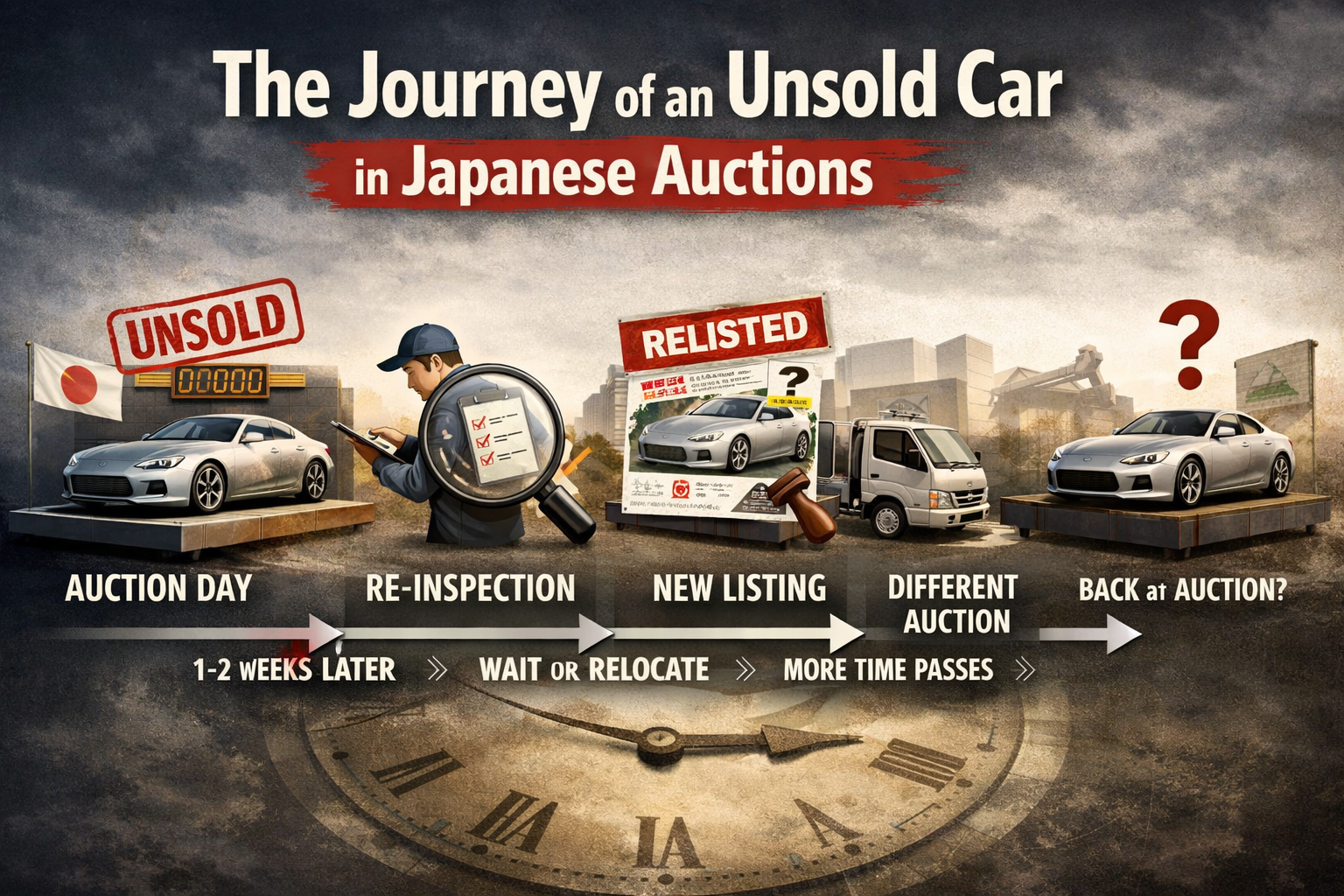
Anyone who follows the world of Japanese car auctions will have noticed something interesting:
when a car doesn’t sell, it doesn’t come back immediately, and above all, it never comes back on a fixed schedule.
This isn’t random, and it’s not a flaw in the system.
It’s the result of a very precise mechanism, typical of the Japanese market, where strategy, structure, and value protection come before everything else.
Let’s look at why this happens.
1. Each auction house has its own rules
In Japan, there isn’t just one auction platform, but dozens of different circuits, such as USS Tokyo or JU Auctions, each with its own internal regulations.
Some auctions:
- relist a car after 1–2 weeks
- require a new registration
- impose a mandatory waiting period before the vehicle can be offered again
This means that unsold does not equal immediately available again.
2. The seller decides when (and if) to try again
When a car doesn’t reach its reserve price, the seller has several options:
- relist it at the same price
- lower the reserve and wait for the next auction
- temporarily withdraw it from the market
- move it to another auction circuit
Many sellers prefer to wait rather than devalue the vehicle through repeated, close-together appearances.
In Japan, a car that “comes back too often” is perceived as less desirable.
3. New inspection means new timing
If the seller decides to relist the car, it often requires:
- a new inspection
- a new auction sheet
- sometimes updated photos
This process isn’t instant.
It can take days or even weeks, especially during busy auction periods.
4. Logistics and the car’s physical location
Unsold vehicles don’t always stay in the same yard:
- they may be moved
- returned to the dealer
- transferred to another auction center
Every logistical movement involves real, technical time, which directly affects when the car reappears.
5. Market strategy (not improvisation)
The Japanese market is extremely rational.
Auctions don’t rely on pressure, but on value credibility.
Bringing a car back immediately after it fails to sell can:
- weaken its perceived value
- attract lower offers
- harm the seller in the medium term
Waiting, instead, often works in the seller’s favor.
In conclusion
If a car you were tracking:
- disappears
- doesn’t come back right away
- reappears weeks later
it’s not an anomaly.
It’s the natural result of a system designed to protect vehicle value,
give sellers flexibility,
and maintain exceptionally high market standards.
And it’s also one of the reasons why Japanese auctions remain the most reliable in the world.